
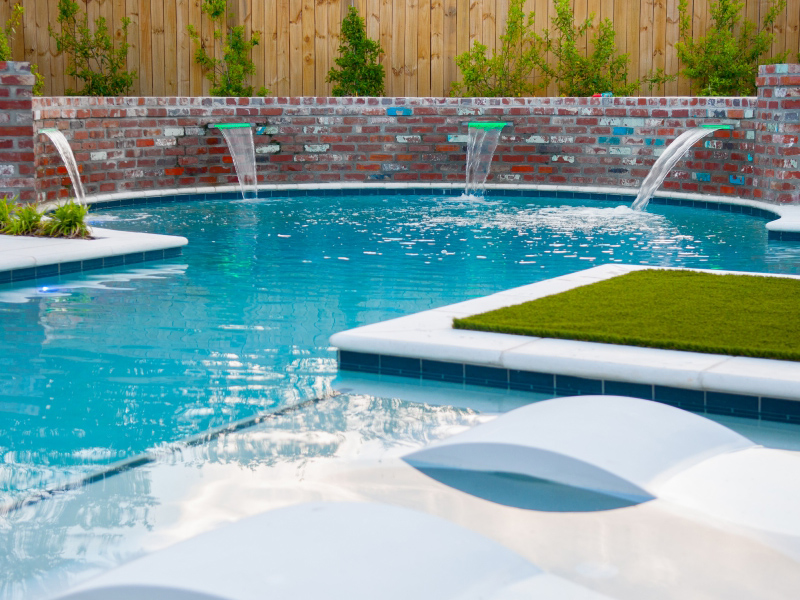
An attached gunite spa is one of the most enjoyable features a custom pool can have — a private retreat that’s always ready, seamlessly connected to your pool, and built to last as long as the pool itself. But when something goes wrong, figuring out where the problem actually lives can be frustrating.
Unlike a freestanding portable hot tub with a self-contained control panel and owner’s manual, a gunite spa shares plumbing, equipment, and chemistry with your pool system. That means the troubleshooting process is often different. The fixes sometimes require understanding how your pool and spa work together as a single integrated system.
Here’s a guide to the most common gunite spa problems and how to work through them.
Problem 1: The Spa Isn’t Heating
This is the most common complaint, and it has several possible causes ranging from a simple settings issue to a failing heater element.
Start with the basics:
- Check your diverter valves. In a pool/spa combo, diverter valves control water flow between the pool and spa. If a valve is misaligned, almost all of the water gets directed back to the pool return instead of the spa — leaving the spa with barely any flow and no meaningful heating. Make sure your valves are set correctly for spa mode.
- Check the water level. If the water level is too low, your heater may fire without enough water flowing through it. This causes a dry fire — damaging the heating element. Top off the pool and spa before ruling out other causes.
- Clean the filter. A dirty or clogged filter restricts water flow throughout the entire system, including to the heater. Low pH over time also corrodes the heating element and can trip the GFCI breaker. If your spa was heating fine and suddenly isn’t, start with a filter cleaning.
- Check the bypass valve. If the heater bypass valve is open, water avoids the heater entirely. Keep it closed during the heating season.
If the basics don’t resolve it:
A failing heater element needs testing and replacement by a professional. Modern heaters display error codes or indicator lights that offer useful clues — low water flow warnings typically signal clogged filters or closed valves, while other codes may point to the heater element or thermostat. Don’t ignore error codes. The system is telling you exactly where to look.
Problem 2: Weak or Inconsistent Jet Pressure
Nothing defeats the purpose of a spa faster than jets that barely push water. The fix depends on what’s causing the flow restriction.
Most common causes:
Closed or partially closed jets. Start with the simplest explanation. Turn each of your jets to make sure they’re all wide open, and check them for calcium buildup that may be restricting flow. A single closed jet can affect overall system pressure.
Dirty or clogged filter. When your filter fills with dirt and residue, water can’t flow through it properly — causing the spa to lose pressure or shut down entirely. Regular filter cleaning is the single most important preventive step for consistent jet performance.
Airlock. This is particularly common after draining and refilling the spa. To clear an airlock, open all jets completely and run them on high for 10–15 seconds. Repeat as necessary until you see air bubbling from the jets, then leave them running until all the air releases.
Valve position issues. In an attached gunite spa, diverter valves control how much water routes to the spa jets versus returning to the pool. If a valve isn’t fully diverting to spa mode, your jets will always feel weaker than they should — even with a clean filter and no airlock.
Calcium buildup in the jets. Significant calcium buildup may require more than cleaning — replacing the affected jets might be the best solution. This is more common in spas where water chemistry has run imbalanced for extended periods, particularly when calcium hardness runs high.
Problem 3: Cloudy or Foamy Spa Water
Spa water clouds and foams faster than pool water — and in Baton Rouge’s heat, it can happen quickly. The small water volume of a gunite spa means contaminants concentrate much faster than in the main pool.
Cloudy water:
Low sanitizer levels, imbalanced pH or alkalinity, a dirty filter, or heavy bather load are the most common causes. When sanitizer drops below 1.0 ppm, organic contaminants grow faster than the system can destroy them. Maintain 3–5 ppm of chlorine or 4–6 ppm of bromine at all times.
Biofilm — a slimy layer of bacteria that coats the inside of pipes and fittings — can also cloud the water and cause foaming in extreme cases. If you suspect biofilm contamination, lower the pH to 7.2, shock the spa to raise chlorine above 10 ppm, then follow up with a jet cleaning product to clear biofilm deposits from the plumbing.
Foamy water:
Skincare products are the number one cause of foamy spa water. Body oils, makeup, hair conditioners, lotions, and detergent residue from swimsuits all end up in the water — consuming sanitizer and causing foam. Encourage everyone to rinse off before using the spa (without soap), and you’ll notice a significant difference.
Low calcium hardness is another common culprit. When calcium levels drop too low, the water loses surface tension and takes on a sudsy appearance. Test and adjust calcium hardness alongside pH and alkalinity whenever foam persists.
When to drain and refill:
If cloudy or foamy water doesn’t resolve with chemical treatment and filter cleaning, the water itself may be spent. Solids build up fast in a spa. Depending on usage, plan to drain and refill every three months or so.
Problem 4: The Spa Pump Is Noisy
A spa pump that runs louder than usual is trying to tell you something.
Grinding or rumbling noise typically points to worn motor bearings — often caused by a leaking shaft seal. A pump with bad bearings can sometimes run for a while before failing completely, but address it as soon as you notice it. Waiting usually turns a bearing replacement into a full pump replacement.
Cavitation — a high-pitched whining or rattling — occurs when the pump isn’t receiving enough water to operate properly. A clogged filter, low water level, a closed valve, or an air leak on the suction side can all cause this. If the pump runs but doesn’t circulate water effectively, check the filter, water level, and valves first.
Any unusual pump noise that doesn’t resolve immediately after those checks needs a professional. Pump issues in an attached gunite spa affect the entire pool system, not just the spa.
Problem 5: The GFCI Breaker Keeps Tripping
If your spa’s GFCI breaker trips repeatedly, do not simply reset it and move on. A GFCI trips because it detected an electrical fault — and that fault represents a real safety risk near water.
The GFCI shuts off automatically when it detects a fault that could cause electrocution. Common causes include a failing heater element, damaged wiring, or moisture reaching an electrical component. To help pinpoint the culprit, disconnect components one at a time. If the breaker stays on after removing a specific component, that component is likely the cause.
This is not a DIY repair. Always have a licensed professional handle electrical work on pool and spa equipment.
A Note on Gunite Spa Chemistry vs. Pool Chemistry
Many gunite spa owners don’t realize how differently chemistry behaves in a spa versus a pool. Because the spa’s water volume is much smaller, imbalances hit faster and harder. A minor issue that barely registers in a 20,000-gallon pool can turn a 400-gallon spa noticeably cloudy or foamy within hours.
When pool and spa share water — as most attached gunite spas do — chemistry management stays largely unified.
When you isolate the spa for heating cycles, monitor it more closely. Heat accelerates chlorine burn-off, raises pH, and concentrates everything in the water faster than the pool alone would.
Test your spa water separately from your pool whenever you run it in isolated spa mode. Rebalance after any extended use session.
When to Call PEC
Some spa problems are straightforward to diagnose and fix. Others — a failing heater element, a damaged jet manifold, an underground plumbing leak, or an electrical issue — require a professional with the right tools and experience.
At Pinnacle Exterior Construction, we build custom gunite pools and spas throughout Baton Rouge and the surrounding area. If you’re troubleshooting a spa problem you can’t get ahead of, or if something has changed with your pool and spa system that you can’t explain, our team can diagnose it and get your system running the way it should.
Contact PEC today or explore our pool and spa resources for more guidance on maintaining your investment.